
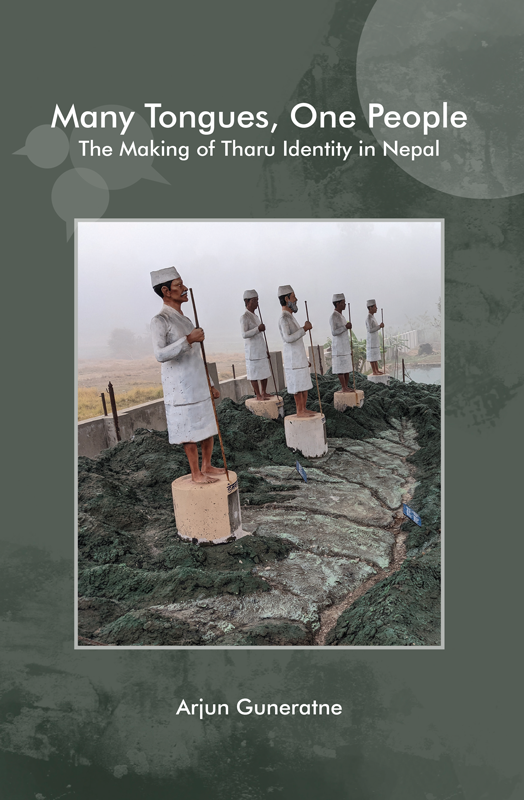
Many Tongues, One Peoples
The Making of Tharu Identify in Nepal
₨ 890
The tharu of lowland Nepal are a culturally and linguistically diverse peole who, only a few generation ago, would not have acknowledged eachother as belonging to the same ethnic group. ...read more
Additional information
-
ISBN:
978-9937-179-63-8
-
Language:
English
- Published Year : 2025
Description
Many Tongues, One People: The Making of Tharu Identity in Nepal
Arjun Guneratne
2025, pp. xxiv+252
The Tharu of lowland Nepal are a culturally and linguistically diverse people who, only a few generations ago, would not have acknowledged each other as belonging to the same ethnic group. Today the Tharu are actively redefining themselves in Nepal’s mutiethnic polity. In Many Tongues, One People, Arjun Guneratene argues that shared cultural symbols—including religion, language, and common myths of descent—are not a necessary condition for the existence of a shared sense of peoplehood.
The many diverse and distinct sociocultural groups sharing the name “Tharu” have been brought together, Guneratne asserts, by a common relationship to the state and a shared experience of dispossession and exploitation that transcends their cultural differences. Tharu identity, the author shows, has developed in opposition to the activities of a modernizing, centralizing state and through interaction with other ethnic groups that have immigrated to the Tarai region where the Tharu live.
______________________________________________________________________________________________________
Arjun Guneratne is Professor and Chair of Anthropology at Macalester College in Saint Paul, Minnesota. He received his PhD from the University of Chicago in 1994. Besides authoring Many Tongues, One People, he has edited Culture and the Environment in the Himalaya (Routledge 2010), The Tarai: History, Society, Environment (Himal Books 2011) and Pathways to Power: The Domestic Politics of South Asia (with Anita Weiss, 2014). He was formerly the editor of Himalaya, the journal of the Association for Nepal and Himalayan Studies. His current projects include a history of ornithology in Sri Lanka, and he has written extensively on the Tharu, on caste, the history of biodiversity conservation in Sri Lanka, and on birds. He has served at various times and in various capacities in the Association for Asian Studies, the Association for Nepal and Himalayan Studies, and the American Institute for Sri Lankan Studies.
Only logged in customers who have purchased this product may leave a review.
Related products
-

-

-
 ₨ 650 Add to cart
Academic Writing and Publishing in Health and Social Sciences
Sharada P. Wasti, Edwin van Teijlingen, Padam P. Simkhada and Vanora Hundley with Khem Shreesh
Reviews
There are no reviews yet.